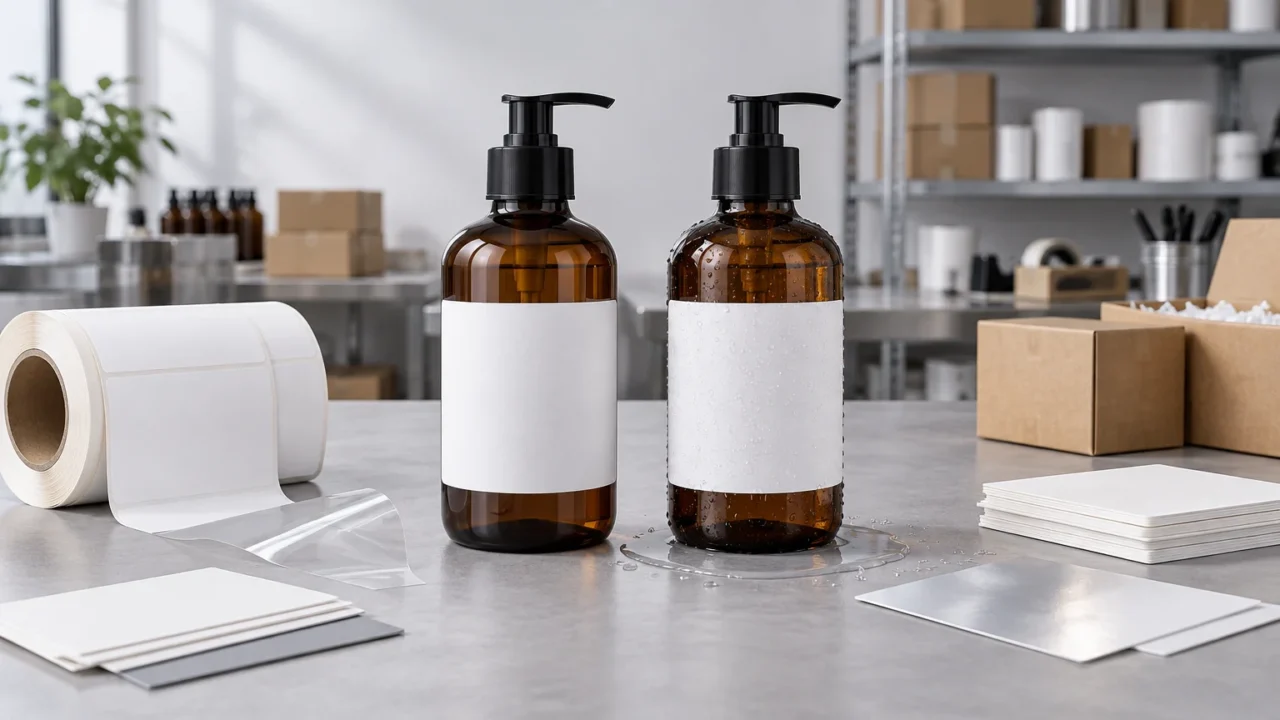
TLDR: In the waterproof vs water resistant labels decision, neither term is a complete production specification. Water-resistant labels may be suitable for occasional splashes or condensation, while a supplier-supported waterproof construction should address prolonged or repeated water exposure. In both cases, confirm the facestock, adhesive, print durability, protective finish, package surface, application conditions, and expected service life. Test the complete label on the actual package before ordering production volume.
A label does not succeed because its facestock repels water. It succeeds when the entire construction remains attached, readable, and presentable under the conditions the product actually encounters. A film label with the wrong adhesive can peel. A strongly bonded label can remain attached while its ink rubs away. A construction that survives refrigerator condensation can still fail during immersion or repeated cleaning.
Waterproof vs water-resistant labels: the practical difference
There is no universal performance threshold in the supplied evidence that makes every label marketed as “water-resistant” or “waterproof” equivalent. Treat both terms as starting points for a supplier conversation, not as acceptance criteria.
| Label description | Reasonable buying interpretation | What still needs to be specified |
|---|---|---|
| Water-resistant | Designed for limited contact with moisture, such as brief splashes, damp handling, or condensation | Exposure duration, liquid, temperature, handling, drying cycles, and acceptable appearance |
| Waterproof | A supplier-supported claim for a defined level of water exposure | Whether the claim covers attachment, printed image, edges, abrasion, and the required exposure period |
| Weatherproof or outdoor | Intended for some combination of rain, sunlight, temperature changes, and outdoor handling | Outdoor service life, orientation, UV exposure, surface, climate, and cleaning |
| Durable or industrial | Built for demanding service conditions or identification requirements | Applicable chemicals, abrasion, heat, humidity, surface, standards, and required readability |
This distinction matters in purchasing. “Needs to survive a wet environment” is too broad. “Must remain attached and scannable on a refrigerated polypropylene bottle through seven days of condensation and daily handling” gives a converter or printer something concrete to evaluate.
Specify the complete label system
Durability comes from interacting components. UL Solutions’ marking and labeling guidance evaluates the complete label system in relation to its application surface and intended conditions of use. Its listed concerns include adhesion loss, legibility, shrinkage, curling, water, humidity, heat, sunlight, and chemicals. That system-level approach is useful even when a project does not require formal certification.
1. Facestock
The facestock is the visible base material. Coated paper can be adequate when exposure is brief, controlled, and supported by the supplier’s construction data. It is generally a poor default when the label will experience persistent moisture, repeated wet handling, or conditions that can reach exposed paper edges.
Film is the more sensible baseline for many demanding wet-use applications because film label materials are offered for water- and moisture-resistant uses. Selection still depends on the application, container material, and required flexibility or conformability. “Film” is a material category, not a guarantee that every construction will work on every package.
2. Adhesive
The adhesive has to match the package surface as well as the environment. Adhesion can differ across polycarbonate, polypropylene, stainless steel, glass, HDPE, coated board, and other materials. A 3M technical data sheet for one polyester label material reports different typical peel-adhesion values on polycarbonate, polypropylene, and stainless steel after a 72-hour dwell. The specific values apply to that construction, but the broader lesson is important: changing the package surface can change the bond.
Surface texture and shape also matter. A stiff label may try to lift from a small-radius bottle. Mold-release residue, oils, dust, or condensation can interfere with contact. Low-surface-energy plastics such as polypropylene often require particular attention to adhesive compatibility rather than a generic permanent-adhesive selection.
3. Print method and image durability
A label can stay attached and still fail operationally if text smears, a barcode loses contrast, or colors abrade during packing. Ask whether the printed image is suitable for the expected liquid, handling, cleaning chemical, and scuff exposure. For variable-data labels, evaluate the durability of the variable print as well as the preprinted graphics.
4. Protective finish
A varnish, coating, or overlaminate can protect the printed surface, but it should solve an identified problem. For one polyester durable-label construction, 3M states that an overlaminate can improve resistance to moisture, tearing, cracking, and abrasion. That supports evaluating lamination for repeated handling or cleaning, not automatically adding it to every label.
An overlaminate cannot correct an adhesive that is incompatible with the container. It may also change stiffness, edge behavior, appearance, recyclability considerations, and cost. Define the failure risk first, then select the finish.
5. Application surface and process
A durable label needs a controlled application process. The 3M data sheet instructs users to apply its material to clean, dry surfaces, notes that low application temperatures can limit adhesive contact, and states that additional rubdown pressure can improve initial bond. These principles are useful checkpoints, although the approved application range and pressure should come from the selected material’s own data.
Document whether labels are hand-applied or machine-applied, the package temperature at application, the pressure available, and the time before exposure. A label placed on a cold, damp bottle immediately before refrigeration presents a different challenge from one applied to a clean, room-temperature bottle and allowed to dwell before filling.
6. Service environment
List the conditions the label must survive rather than naming one general property. Include water source, duration, frequency, temperature, chemicals, sunlight, abrasion, flexing, storage time, and required readability. If the label carries warnings, ratings, safety information, or regulated identification, determine the applicable compliance and durability requirements instead of relying on marketing terminology.
Match the construction to the exposure
| Use case | Starting specification direction | Primary validation concern |
|---|---|---|
| Occasional splashes on a dry indoor package | Supplier-supported water-resistant paper or film construction may be adequate | Staining, edge absorption, ink rub, and appearance after drying |
| Refrigeration and condensation | Film construction with adhesive selected for the container and application temperature | Bonding to the actual surface, edge lift, wet handling, and repeated condensation cycles |
| Repeated wipe-down | Durable film and print system; evaluate a protective finish where abrasion or chemicals threaten the image | Cleaner compatibility, scuffing, legibility, and adhesive exposure at the edges |
| Outdoor product or equipment | Construction documented for the expected outdoor conditions | Water, sunlight, temperature cycling, fading, shrinkage, and edge lift |
| Immersion or high-consequence identification | Supplier-supported construction for the defined exposure; formal review where required | Attachment and readability after the full exposure period, including handling and chemicals |
These are specification starting points, not universal ratings. A condensation-resistant refrigerated label does not automatically qualify for an ice bucket, dishwasher, marine setting, or repeated sanitizing process. Water temperature, dwell time, dissolved chemicals, movement, and mechanical rubbing can change the outcome.
For more format-specific context, see the guide to waterproof vinyl stickers for bottles, packaging, and outdoor branding. When sourcing custom stickers and roll labels, provide the real package and exposure requirements rather than requesting “waterproof” material without further detail.
Diagnose the failure, not just the material
Common failures point to different parts of the system. Reordering the same design on a thicker or more expensive film will not necessarily solve the underlying problem.
- Edge lift or peeling: Review surface energy, contamination, package curvature, adhesive choice, label stiffness, application temperature, pressure, and dwell time.
- Curling or shrinkage: Review facestock stability, moisture and heat exposure, label dimensions, finish, and whether the construction is conformable enough for the package.
- Tearing or edge damage: Review film toughness, die-cut quality, exposed edges, handling, and whether an overlaminate is justified.
- Ink smear or image rub: Review the print process, ink or toner compatibility, cure, coating, overlaminate, cleaning chemicals, and abrasion.
- Fading or discoloration: Review sunlight exposure, print system, material data, and required outdoor service life.
- Barcode or small-text failure: Measure readability after moisture, abrasion, handling, and cleaning—not only immediately after printing.
Peel adhesion is one useful test measure. ASTM lists peel-adhesion standards including ASTM D3330/D3330M and ASTM D6252/D6252M. A peel result does not by itself prove that a label will remain readable, resist abrasion, or survive a wet-use cycle, so it should be part of a broader validation plan.
Run a pre-production label test
A sample test is most useful when it reproduces production conditions. Applying a label to a clean glass panel in an office does not validate its performance on a curved HDPE bottle coming off a cold filling line.
- Identify the actual package material, finish, shape, and supplier. Include every package variant if surfaces differ.
- Record the label application temperature, package condition, application method, pressure, and expected dwell time before filling, refrigeration, shipping, or water exposure.
- Define the liquid exposure. Note whether it is condensation, splashing, rain, immersion, ice water, cleaning solution, oil, or another substance.
- Reproduce expected handling, including rubbing, wiping, carton contact, flexing, and repeated wet-dry cycles.
- Inspect attachment, edge lift, wrinkles, tears, shrinkage, color change, ink transfer, and finish damage at planned intervals.
- Scan every barcode type and verify small text after exposure. Visual survival is not enough if warehouse or checkout systems cannot read the code.
- Test multiple samples and package positions. One successful label is not evidence of a repeatable process.
- Keep the approved construction, supplier material codes, artwork version, application settings, test conditions, and results in the production specification.
If packaging security is also part of the project, moisture performance should be tested alongside the opening and inspection process. A tamper-evident label system adds package geometry, evidence of opening, application equipment, and inspection requirements to the validation plan.
The purchasing specification to send your printer
Before requesting quotes or samples, prepare a short requirement sheet. State the package material and shape, surface condition, application method, application temperature, dwell time, exposure liquid, exposure duration and frequency, handling, cleaning chemicals, storage conditions, service life, and required readability. Add any compliance requirement and define what constitutes failure.
Then ask the supplier to identify the complete proposed construction: facestock, adhesive, print process, ink or toner system, coating or overlaminate, and any limits that apply. Obtain samples made as close as practical to the production construction and test them on actual packages.
Choose for the real environment
The right answer in the waterproof vs water resistant labels comparison is the least complex construction that reliably survives the documented use case. Occasional splashes may not justify an industrial construction. Repeated condensation, immersion, outdoor exposure, sanitizing, or high-consequence identification should not be entrusted to an undefined waterproof claim.
Start by documenting the surface, application conditions, liquid exposure, handling, service life, and required readability. Use that record to obtain supplier-supported samples, test the complete label system, and preserve the approved specification for repeat orders. That process turns a vague durability request into a label your packaging operation can reproduce.
References
- Marking and Labeling Testing and Certification | UL Solutions
- Marking and Labeling Systems FAQs | UL Solutions
- Film Materials Technical Guide
- label.averydennison.com
- multimedia.3m.com
- 3M™ Sheet and Screen Label Material 7905, Clear Polyester Gloss, Roll, Config | 3M United States
- BOS Standards – Standards Products – Standards & Publications – Products & Services