
TLDR
Specify tamper evident labels by starting with the event they must reveal: opening a cap, lifting a carton flap, removing an enclosure cover, or accessing a protected component. Then select the failure mode, material, adhesive, dimensions, printed message, roll format, and application process around that event. Approve the construction only after testing it on production-equivalent packages under relevant storage, shipping, and opening conditions.
Do not treat tamper evident labels as a generic permanent sticker. A label can adhere strongly and still provide poor tamper evidence if it sits outside the opening path, lifts cleanly, becomes unreadable, or cannot be inspected quickly. The working specification must cover the label and package as one system.
Define the evidence before choosing the label
The first decision is not paper versus film. It is what an operator, retailer, technician, or customer should see after someone attempts to open or remove the label.
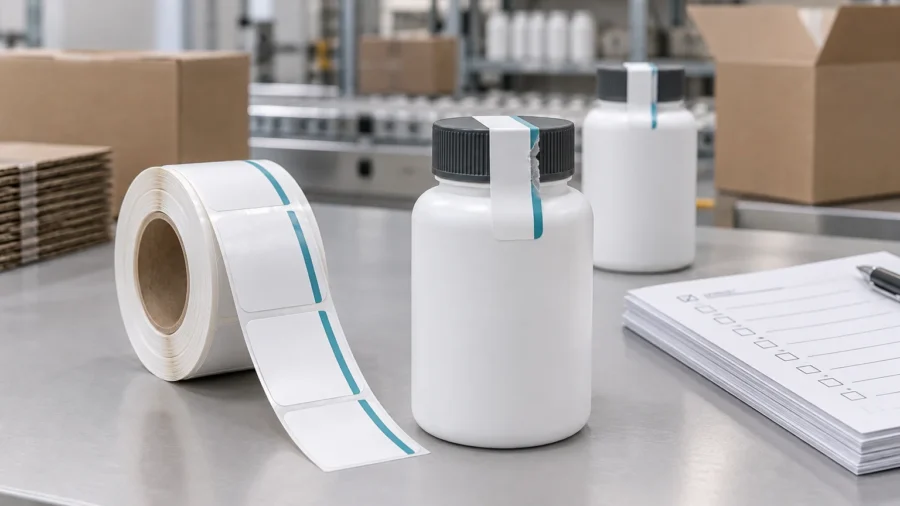
A transferable VOID construction leaves a visible word or pattern on the application surface. A non-transfer construction reveals evidence within the label itself. A destructible film fractures into pieces instead of peeling away intact. A closure-bridging seal crosses two package components and breaks or distorts when they move apart.
Technical information from Avery Dennison describes tamper-evident polyester constructions that reveal a visible word or pattern when disturbed. It also distinguishes tamper-evident performance from a claim that a package is tamper-proof. The EUIPO similarly describes VOID labels as visible anti-tampering or anti-alteration technology, not as a connected product-authentication system.
That boundary matters. A tamper-evident label can show that access may have occurred, but it does not automatically prevent access, establish product authenticity, provide child resistance, or satisfy a regulated package requirement.
Compare the principal constructions
| Construction | Visible response | Good fit | Main qualification question |
|---|---|---|---|
| Transferable VOID film | A word, pattern, or image transfers to the package surface | Cartons, enclosures, warranty seals, and assets where residue is acceptable | Will the transfer pattern develop reliably and remain visible on the actual surface? |
| Non-transfer VOID film | The hidden message appears in the lifted label without leaving the full pattern on the package | Surfaces where residue is undesirable or difficult to inspect | Can inspectors recognize the activated label quickly and consistently? |
| Destructible or frangible film | The label fractures, stretches, or separates into pieces during removal | Warranty seals, closures, access points, and small components | Is the film fragile enough to show removal without failing during dispensing or application? |
| Closure-bridging seal | The label breaks, wrinkles, or visibly separates when two package parts move | Bottle caps, jar lids, carton flaps, tubs, and hinged enclosures | Does every normal opening path force a visible disruption? |
No construction is universally best. Transfer residue may be valuable on a smooth carton but inconsistent or undesirable on a textured container. A highly frangible material may produce clear evidence after application yet create dispensing problems if the die cut, matrix removal, liner, or applicator setup is poorly matched to it.
Place the label in the opening path
A tamper-evident feature works only when opening the package forces a change that can be seen. A label placed entirely on the bottle body may identify the product, but it does not reveal that the cap was removed. For that use, the label normally needs to bridge the cap and container or interact with another closure feature.
Map the package-opening sequence before requesting a quote. Identify every flap, seam, cap, lid, hinge, latch, or removable panel that provides access. Then ask whether a person could reach the contents without disturbing the proposed seal. If the answer is yes, change the placement, use multiple seals, or reconsider the complete package design.
The inspection point is equally important. Decide who checks the feature, when the check happens, and what constitutes failure. A warehouse receiving team may need a large, unmistakable broken bridge. A service technician may be able to inspect a smaller VOID message under controlled lighting.
Match the facestock and adhesive to the real surface
Material names alone do not define performance. Record the package substrate—such as HDPE, polypropylene, PET, glass, coated paperboard, or powder-coated metal—along with texture, curvature, coatings, recycled-content variability, and likely contamination. Adhesive and material selection should be matched to the application surface and use conditions rather than reduced to a request for a generic permanent adhesive.
Include the application temperature and the environmental exposures expected after labeling. Refrigeration, condensation, water, oil, cleaners, heat, ultraviolet exposure, abrasion, and repeated handling can change the result. If the label must function as durable product marking as well as a tamper feature, review any applicable marking-system requirements. UL explains that ANSI/UL 969 evaluations can address label permanence under exposures including water or humidity, elevated temperature, sunlight, and chemicals.
Peel adhesion data can help compare pressure-sensitive constructions, but it is only one input. ASTM D3330/D3330M addresses peel adhesion testing for pressure-sensitive tape; that measurement does not by itself show whether a finished package will produce the intended transfer, fracture, or opening evidence.
Set dimensions from package trials, not a universal rule
The label must provide enough bonded area on both sides of a closure while tolerating curvature and normal package movement. A narrow bridge may break too easily during distribution. An oversized seal can wrinkle around a cap, lift at an edge, cover required copy, or slow manual application.
Begin with a physical package sample. Mark the opening path, measure the available flat or gently curved bonding areas, and note seams or raised features. Test more than one geometry if the package has a tight radius. Rounded corners often reduce vulnerable edge points, but corner treatment and die shape still need to be evaluated on the actual construction.
Printed content should help inspection rather than merely decorate the seal. Depending on the workflow, that can include a short instruction such as “Do not use if seal is broken,” a distinctive brand pattern, lot or expiration fields, or serialized data. A barcode or QR code can support traceability, but scanning does not replace visible tamper evidence unless the entire inspection system was designed around that data.
Lock the roll and application specification
A qualified label construction can still fail operationally if the delivered roll does not fit the application process. State whether labels will be applied by hand, with a dispenser, on semi-automatic equipment, or through an automatic labeler.
- Applicator manufacturer and model, when equipment is used
- Required core inside diameter and maximum roll outside diameter
- Unwind direction, based on the label orientation entering the applicator
- Label width and length, web width, pitch, and gap
- Labels per roll and acceptable roll-to-roll quantity tolerance
- Liner and sensing requirements, including gap, mark, or other detection method
- Splice policy and any maximum number of splices per roll
- Variable-print method and the area reserved for lot, date, serial, barcode, or QR data
These fields belong on the approved artwork and purchasing specification, not in an email thread that disappears before the repeat order. For broader advice on connecting materials to production conditions, see choosing print solutions for labels and packaging. If you are comparing sources for custom stickers and roll labels, confirm explicitly that the supplier can provide the required tamper-evident construction; ordinary sticker materials should not be assumed to have security behavior.
Worked example: a seal for an HDPE bottle with a PP cap
Consider an ecommerce product packed in an HDPE bottle with a polypropylene screw cap. The operational requirement is visible evidence if the cap has been turned before shipment or customer receipt.
The starting concept could be a narrow film seal bridging the top or side of the cap and the bottle shoulder. The construction might use a destructible film or a VOID response, but neither should be approved from a catalog description alone. HDPE and PP can be difficult bonding surfaces, while the bottle shoulder introduces curvature. The exact adhesive, dimensions, bridge position, and dwell time therefore remain qualification items.
For a useful trial, apply candidate labels to production-equivalent bottles and caps after the normal filling and wipe-down process. Include packages from more than one production lot if resin, texture, or recycled content can vary. Check immediate edge contact, then inspect after a defined dwell period. Open the cap normally and record whether the seal fractures or reveals its message before access.
Next, expose samples to the conditions the package will actually encounter, such as warehouse storage, parcel shipping, refrigeration, moisture, or product residue. The acceptance criteria might require no unintended edge lift before opening, visible evidence after cap rotation, legibility at the normal inspection distance, and reliable dispensing from the intended roll-label equipment. Those are example criteria, not universal pass limits.
Validate the package system before release
Use a documented trial rather than informal approval from one attractive sample. The test plan should represent the final container, closure, label, application method, dwell time, and distribution environment.
- Apply labels to clean production-equivalent packages using the intended manual or automated process.
- Inspect placement, wrinkles, edge contact, and accidental activation immediately after application.
- Allow the defined dwell time under controlled conditions, then inspect adhesion again.
- Attempt normal opening and deliberate label removal. Record transfer, fracture, stretching, residue, and inspectability.
- Expose additional samples to relevant heat, cold, moisture, abrasion, chemicals, shipping, or storage conditions.
- Repeat the opening and removal checks after exposure.
- Record photographs, package lots, label lots, conditions, and pass-or-fail results.
- Approve one controlled specification covering construction, artwork, dimensions, roll format, application settings, and acceptance criteria.
This record turns a successful trial into a repeatable order. It also helps operations isolate changes when a later batch behaves differently. A broader print control process can keep labels, inserts, and packaging aligned across replenishment cycles; see print solutions that keep packaging and operations on track.
Screen regulated packages separately
Regulated uses require package-level review rather than a conclusion based on the label alone. For certain over-the-counter human drug products, the FDA’s tamper-resistant packaging guidance addresses visible evidence of tampering, a distinctive design or identifying characteristic, and an appropriate labeling statement. FDA also distinguishes child-resistant packaging from tamper-evident packaging; providing one feature does not establish the other.
Food, cosmetics, medical products, electrical equipment, retailer programs, and customer contracts can introduce different requirements. Confirm the applicable rules and acceptance process with the responsible regulatory, quality, or compliance team before production. Do not present a material supplier’s generic data sheet as proof that the complete package complies.
What to send with a quote request
- A production-equivalent package and closure sample
- The substrate names, coatings, texture, curvature, and cleaning process
- The opening path and required visible response
- Preferred transfer, non-transfer, fracture, or bridge behavior
- Label dimensions to trial, rather than an untested final size
- Required warning copy, branding, variable data, and inspection distance
- Application temperature, dwell time, storage, shipping, and exposure conditions
- Manual or automated application details and complete roll requirements
- Expected order quantity and repeat-order pattern
- Written pass-or-fail criteria for adhesion, edge lift, activation, and inspectability
Build the specification around the tamper event
The most reliable buying sequence is straightforward: define the access event, select the visible failure mode, test candidate constructions on the final package, qualify the application process, and document the approved roll specification. This prevents purchasing from substituting a visually similar label that behaves differently on the line or in use.
For the next step, gather the package sample, surface description, opening sequence, environmental conditions, equipment requirements, and acceptance criteria. Ask the label supplier for a material and application trial—not merely a price for a “permanent tamper label.” That distinction is what turns tamper evidence from a printed claim into a controlled packaging function.
References
- Tamper Evident Polyesters Technical Marketing Bulletin
- Void Labels | Anti-Counterfeiting and Anti-Piracy Technology Guide
- 3M™ Tamper Evident Label Material 7381/7866 | 3M United States
- Marking and Labeling Systems Program | UL Solutions
- D3330/D3330M Standard Test Method for Peel Adhesion of Pressure-Sensitive Tape
- CPG Sec. 450.500 Tamper-Resistant Packaging Requirements for Certain Over-the-Counter Human Drug Products | FDA
- Over-the-Counter Medicines: What's Right for You? | FDA